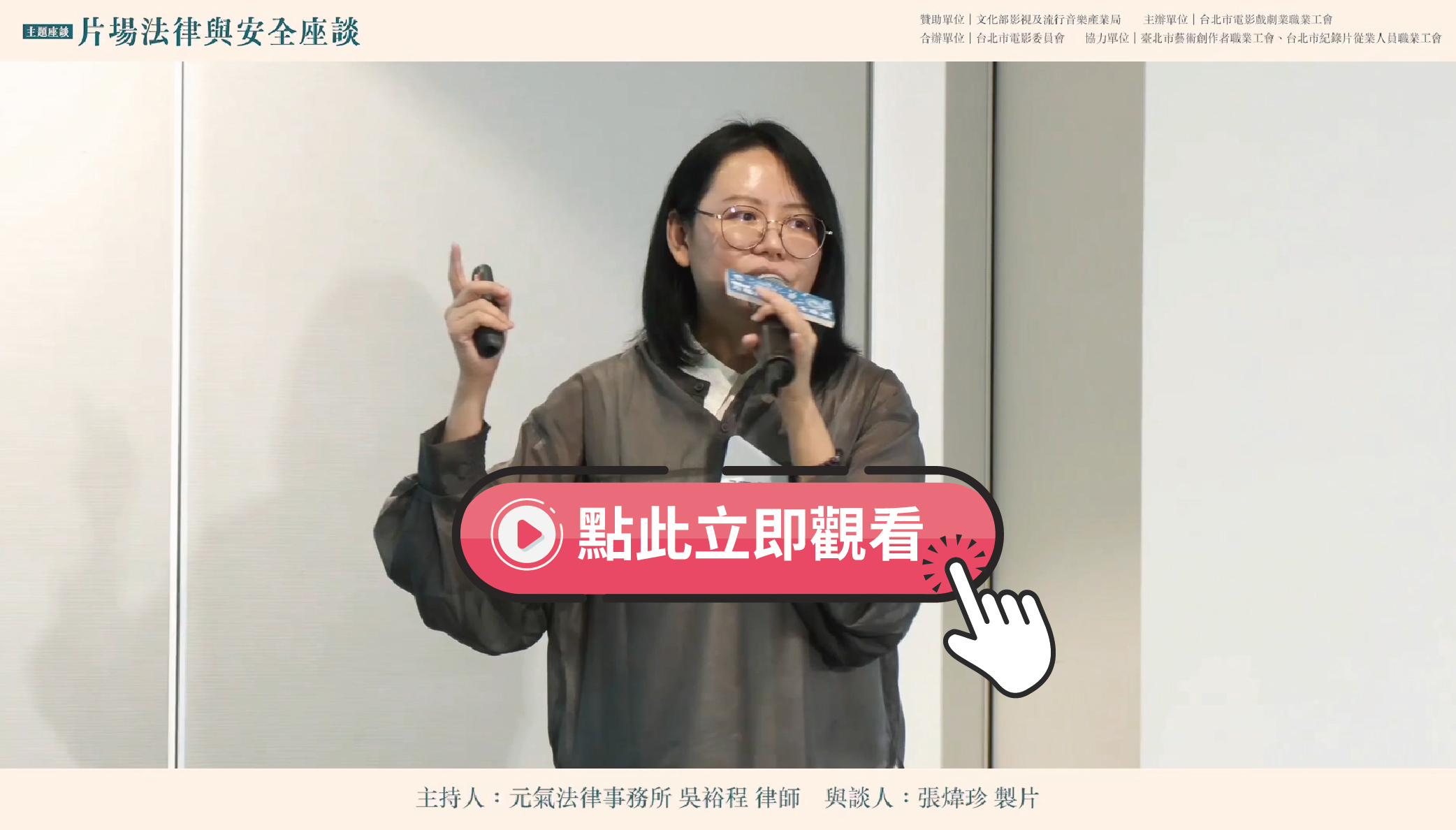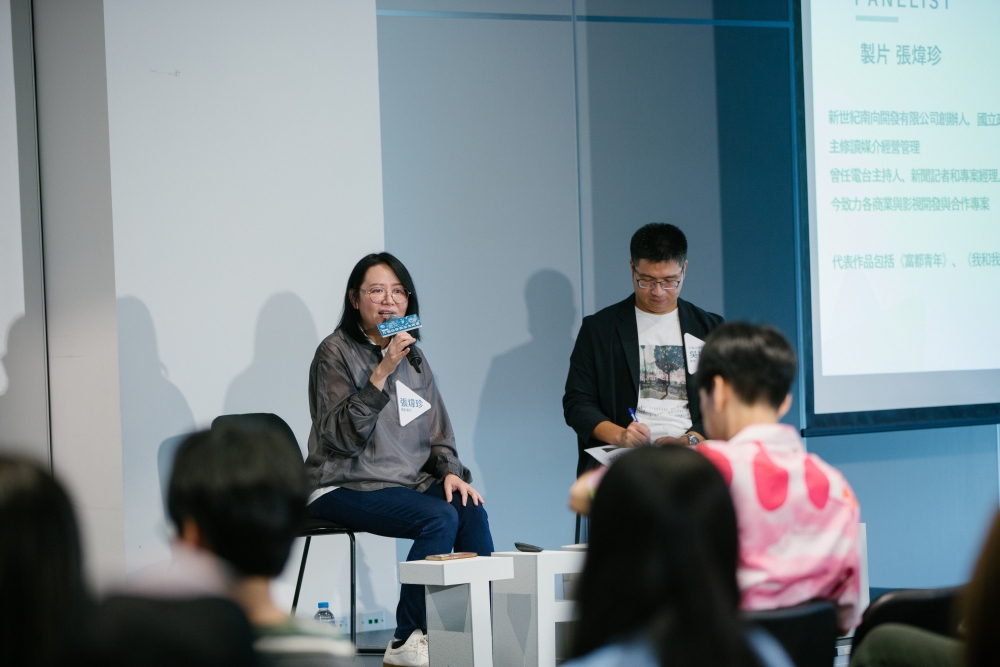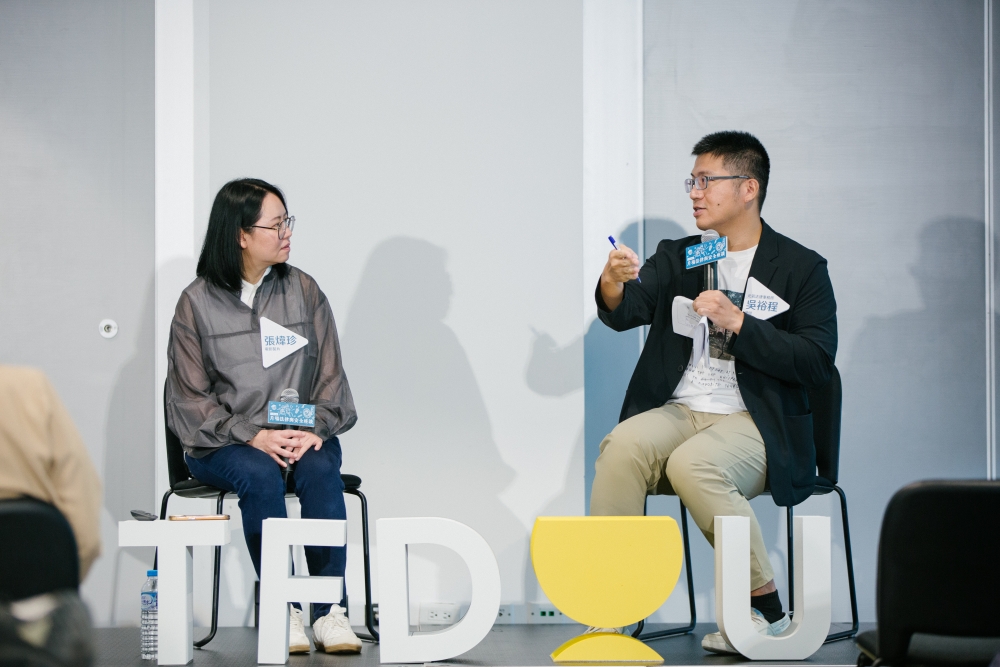


9/9下午【片場法律與安全座談|契約實務】IP改作契約擬定與規劃製片契約擬定與規劃
在風險與希望之間:跨國電影投資的實戰心法 | 主講人:張煒珍 製片Nicole Teoh
從數字到創意,從合約到信任,張煒珍製片分享跨國合製的挑戰與可能
來自馬來西亞的張煒珍,從新聞記者轉入影視製作,帶著對故事的敏銳觀察力與國際產業的現實體驗,分享她如何在台馬跨國合製的實踐中,一步步學習投資結構、跨文化溝通,以及風險控管的必然功課。她坦言,影視作品的誕生不只倚靠熱情與創意,更需要精準的資金規劃與嚴謹的法律機制,才能在跨國合作的迷宮裡走得穩健。
跨市場的必然選擇:疫情之後,投資與合製的新路徑
張煒珍指出,疫情讓電影投資的困境被放大,單一市場已難以支撐一部電影的資金需求,跨國合作成為新常態。各國投資方通常會提出條件,例如要求使用在地演員與團隊,作為投資前提;而回收機制也必須多元,從票房到串流平台的分潤,都需在合約中明確規劃。
她舉例自己的經驗:一部台馬合作的作品,團隊跨國拍攝、雙地演員參與,雖能擴大市場能見度,卻也面臨文化差異、法規限制與溝通成本等挑戰。對她而言,導演的拍攝動機與誠意往往是說服投資方的關鍵,「當我們相信一個故事值得被拍出來,就要找到能完成它的路。」
動機的力量:說服投資方的第一步
在面對投資方時,話術與態度缺一不可。張煒珍分享,曾對馬來西亞的出資者說:「連台灣導演都想拍馬來西亞的故事,你更應該支持。」這樣的話不只是一句推銷,而是對當地文化的肯定與情感連結。
同時,她更強調製片方肩負的長期責任。投資回收並非短期行為,她必須保存八至十年的財務報表,管理結算與分潤節點。這些報表中既有成功的案例,也有失敗的專案,若長期累積失敗,將直接影響團隊的信譽與未來籌資的難度。
資金結構與風險控管
資金的進出是跨國合製的核心風險之一。張煒珍提醒,必須:
·鎖定唯一匯款帳戶,若更改須書面修訂。
·建立收款驗證 SOP,避免捲入洗錢嫌疑。
·注意匯率與匯損:建議各幣別獨立定價,而非依即時匯率。
·明確寫入資金來源合法性條款,若遇不法資金,製片方才能自保為受害者。
在投資比例與查帳權上,她提出一項實用談判技巧:若投資方堅持查帳,製片方可要求其在專案超支時,依比例共同承擔。這樣能讓權利與義務對等,也減少行政成本的壓力。
拍攝現場的邀請:讓投資人看見電影人的心血
投資並不只是冷冰冰的數字。張煒珍分享,她會邀請投資方參觀拍攝現場,或在殺青宴播放幕後花絮,讓投資人親眼看見劇組的努力與付出。她笑說,不止一次在現場獲得投資方「加碼承諾」,因為當下的氛圍喚起了對電影的熱情與信任。
分紅的藝術:在回本與利潤之間找到平衡
張煒珍也特別提到,製作團隊的獎金機制往往是激勵士氣的重要元素。亞洲慣例通常落在 10%至30%,而美方投資人則習慣將比例拉高到 50%。這樣的差異,不只是數字上的不同,更反映出不同市場對「回報」的理解與期待。因此,在設計合約時,製片方必須清楚規劃:究竟是 「回本即分紅」,還是 「回本加上利潤後再分紅」。這兩種方案的選擇,會直接影響到投資方的信任感與團隊的積極度。
她提醒,不論比例多寡,關鍵都在於與投資方的溝通與協商。因為獎金不只是數字,而是合作關係中最敏感、卻也最能凝聚團隊向心力的環節。
海外合約的細節:保險、法律與不容忽視的文字
跨國拍攝牽涉的法律與行政程序繁複:例如馬來西亞要求劇本送審,且需由具相關執照的公司提交。
另外,發行權必須在合約中明定,避免後續權利歸屬混亂。片場安全由當地執行單位負責,並在合約中標明責任。海外投資人高度重視保險,並會要求在撥款前提供主創合約、專戶證明及定稿劇本。
她提醒,跨國合製必須在初期就處理好這些細節,否則後續往往難以補救。
專案退場的藝術:如何好好分手
最棘手的情況,是專案中途退出。張煒珍強調,合約必須明確約定「退場機制」:
投資全數退還,著作權回歸創作者;或投資方撤資時,產出成果的著作權如何分配。
她提醒現場觀眾,製作方絕不能忽略「保障創作者權利」的重要性。當投資方倒閉或權利轉移時,若創作者權利失守,後續談判將陷入被動。
創作者的核心權利:在困境中守住最初的火種
若投資方倒閉,創作權利可能轉移,後續談判會陷入困境。因此,合約談判的核心原則,應是確保創作者權利。張煒珍鼓勵大家:一次退讓不代表永遠,隨著經驗與作品累積,你的談判籌碼會改變。
最後的提醒:一個祝福,走得更遠
談及跨國投資與合製的複雜性,張煒珍語氣誠懇而堅定。她認為,一個案子若能帶著祝福啟程,就更有機會在後續的路上走得順利。
她提醒製片與創作者們:投資條件不會永遠相同,你的作品與經驗會為你累積談判籌碼。面對強勢投資方時,不必害怕拒絕或退讓,因為每一次談判,都是讓自己更清楚下一次要如何前進的養分。
張煒珍也額外提到,製作團隊其實是有獎金機制,亞洲慣例10%-30%,美方投資人則會習慣50%,因此可以在合約提供回本即分紅或是回本加上利潤後分紅的方案。那麼制定獎金的比例,無論是多少占比,仍然要與投資方協商。
-
-
-
-
Between Risk and Hope: Practical Insights into International Film Investment
Speaker: Producer NICOLE TEOH
From Numbers to Creativity, from Contracts to Trust — Producer Nicole Teoh shares the challenges and possibilities of international co-productions.
Originating from Malaysia, NICOLE TEOH transitioned from journalism into film production, bringing with her a sharp eye for storytelling and firsthand experience in the realities of the global film industry. In her talk, she shared how her journey through Taiwan–Malaysia co-productions taught her to navigate investment structures, cross-cultural communication, and the essential discipline of risk management. She emphasized that filmmaking requires not only passion and creativity, but also precise financial planning and solid legal frameworks — the true foundations that allow cross-border collaborations to move forward with stability.
Cross-Market Collaboration: The Inevitable Path after the Pandemic
According to Teoh, the pandemic amplified the financial challenges facing film investment — a single market alone can no longer sustain the full cost of a feature film. As a result, international co-production has become the new normal.
Investors from different countries often attach specific conditions to their participation — for instance, requiring the inclusion of local actors or production teams as part of their investment terms. Meanwhile, revenue recovery models must also be diversified: from box office returns to streaming platform revenue sharing, each channel needs to be clearly defined and contractually structured to ensure transparency and fairness across borders.
She shared her experience with a Taiwan–Malaysia co-production — a project that involved filming across both countries and featured actors from each side. While this expanded the film’s visibility and market reach, it also introduced new challenges: cultural differences, legal restrictions, and high communication costs.
For her, a director’s motivation and sincerity often play a decisive role in convincing investors.
“When we truly believe a story deserves to be told,” she said, “we must find a way to make it happen.”
The Power of Motivation: The First Step in Winning Over Investors
When it comes to dealing with investors, both presentation and attitude are essential. Teoh recalled telling a Malaysian financier: “Even a Taiwanese director wants to tell a Malaysian story — that’s exactly why you should support it.” It wasn’t merely a persuasive line; it was a statement of cultural affirmation and emotional connection.
At the same time, she emphasized the long-term responsibility that a producer must bear. Investment recovery is not a short-term process — she must retain financial reports for 8 to 10 years, managing settlements and revenue-sharing milestones. Those records contain both successes and failures, and if failures accumulate over time, they can directly affect the producer’s reputation and future fundraising capability.
Financing Structure and Risk Management
The flow of funds is one of the core risks in any international co-production.
ProducerTEOH emphasized several key safeguards to ensure transparency and legal compliance:
·Designate a single remittance account. Any changes must be made through formal written amendments.
·Establish a payment verification SOP to avoid potential involvement in money-laundering allegations.
·Monitor exchange rates and losses: it’s best to fix pricing in separate currencies rather than relying on real-time conversion rates.
·Include a “legal source of funds” clause in the contract — so that in the event of illegal funding, the producer can be recognized as a victim rather than a participant.
On the issue of investment ratios and audit rights, Teoh shared a practical negotiation tip: If an investor insists on the right to audit accounts, the producer can request that they also share responsibility for any budget overruns in proportion to their investment. This ensures balanced rights and obligations while reducing unnecessary administrative pressure on the production side.
Inviting Investors On Set: Let Them See the Heart Behind the Film
Investment isn’t just about cold numbers. TEOH shared that she often invites investors to visit the shooting location or screens behind-the-scenes footage at wrap parties, allowing them to witness firsthand the dedication and teamwork that go into making a film.
She laughed, recalling how more than once, an investor increased their financial commitment on the spot — moved by the energy, passion, and collective spirit they saw on set.
The Art of Profit Sharing: Finding Balance Between Recoupment and Reward
Teoh also highlighted that profit-sharing mechanisms are a vital element in sustaining team morale. In most Asian productions, the bonus pool typically ranges from 10% to 30%, while Western investors often expect up to 50%. This gap, she noted, reflects not only a numerical difference, but also distinct cultural expectations around “return on investment.” When drafting contracts, producers must define clearly whether the revenue split begins “upon recoupment” or only “after recoupment plus profit.” This distinction directly influences both investor confidence and the production team’s motivation — striking the right balance can determine whether a collaboration builds lasting trust or future hesitation.
She emphasized that regardless of the profit-sharing percentage, the real key lies in communication and negotiation with investors. Bonuses are not merely numbers — they represent one of the most sensitive yet most unifying aspects of any collaboration, capable of strengthening trust and team spirit when handled with care.
The Fine Print of International Contracts: Insurance, Legal Terms, and the Power of Words
Coproduction productions involve complex legal and administrative procedures. For instance, in Malaysia, all film scripts must be submitted for government approval and filed through a licensed local company.
In addition, distribution rights must be clearly defined in the contract to prevent future disputes over ownership. On-set safety management is handled by the local execution team, with responsibilities explicitly stated in the agreement.
Foreign investors also place high importance on insurance coverage and often require, prior to fund disbursement, the submission of:
·signed contracts with key creative personnel,
·proof of a dedicated production bank account, and
·the final approved script.
Teoh reminded the audience that in international co-productions, these details must be addressed early in development — once production begins, it is often too late to fix what was overlooked on paper.
The Art of Exit: How to Part Ways Gracefully
One of the most challenging situations in any production is when a partner withdraws mid-project. Producer TEOH emphasized the need for a clearly defined exit mechanism in every contract. Such clauses should specify:
·whether the investment will be fully refunded and copyrights revert to the creator, or
·how the intellectual property rights will be divided if the investor withdraws after partial work has been completed.
She reminded the audience that protecting the creator’s rights is non-negotiable. If an investor goes bankrupt or transfers ownership, and the creator’s rights are not firmly established in writing, the production team will lose leverage in future negotiations. “A good producer doesn’t just know how to start a project,” Teoh said.“They must also know how to end one — fairly, and with everyone’s dignity intact.”
The Core Rights of Creators: Protecting the Spark That Started It All
When an investor goes bankrupt, the ownership of creative rights may be transferred, leaving creators in a vulnerable position during renegotiations.
That’s why, according to TEOH, the central principle of any contract negotiation must be to safeguard the creator’s rights. She encouraged filmmakers not to lose heart:
“Conceding once doesn’t mean conceding forever. As your experience and body of work grow, so will your bargaining power.”
A Final Reminder: A Blessing for the Journey Ahead
When speaking about the complexity of international investment and co-production, Teoh’s tone was both sincere and resolute. She believes that if a project begins with goodwill and mutual respect, it stands a far greater chance of finding success down the road. Her advice to producers and creators was simple yet powerful: Investment terms will never stay the same — your work and your track record will continually reshape your leverage. When facing powerful investors, don’t be afraid to refuse or to step back. Every negotiation, she said, is a lesson that helps you move forward more clearly next time.
Teoh also reiterated that bonus structures remain an essential part of team motivation. While Asian productions typically allocate 10–30%, U.S. investors often expect up to 50%. Therefore, contracts should specify whether the bonus applies upon recoupment or after recoupment plus profit. Regardless of the percentage, she reminded everyone, the key is transparent negotiation with investors — because trust, not numbers, is what sustains long-term collaboration.
📌資訊
名稱:片場法律與安全座談
日期:2025年9月9日(二)~9月10日(三)
地點:臺北文創F廳(台北市信義區菸廠路88號6樓)
主辦:台北市電影戲劇業職業工會
🕒 時間表
📅 9/9(二)多功能 F 廳
10:00–12:00
解析影視與常見契約類型
主持人:元氣法律事務所 吳裕程 律師
與談人:威律法律事務所 周逸濱 律師
13:00–16:00
IP 改作契約擬定與規劃製片契約擬定與規劃:「影視投資」、「跨國合製」、「宣傳傳發行與國際銷售」
主持人:吳裕程 律師
與談人:張煒珍(電影製片)
📅 9/10(三)多功能 F 廳
10:00–12:00
片場安全實戰,現在開始
主持人:吳裕程 律師
與談人:陳克勤(攝影師)、陳啓政(職業安全衛生業務主管)
13:00–16:00
打造災變場景的安心保壘:安全防護與周全規劃
主持人:吳裕程 律師
與談人:許佳明(電影《96分鐘》製片、張亨如(《噬罪者》《模仿犯》導演、林纯羽《哈勇家》《只要我長大》執行製片